5.02.2021

Use DIY tips to fix your car tailgate

This week, Jill Washburn, our Jill of All Trades, shows us how to maintain and / or replace the hydraulic struts that hold the hatches and sometimes the trunks of many vehicles.

Over time, these spacers can dry out, clog with road debris, or simply wear out completely. They are actually quite easy to care for. And if you need a replacement, you can do it yourself too. They are really very affordable and the solution is quick.
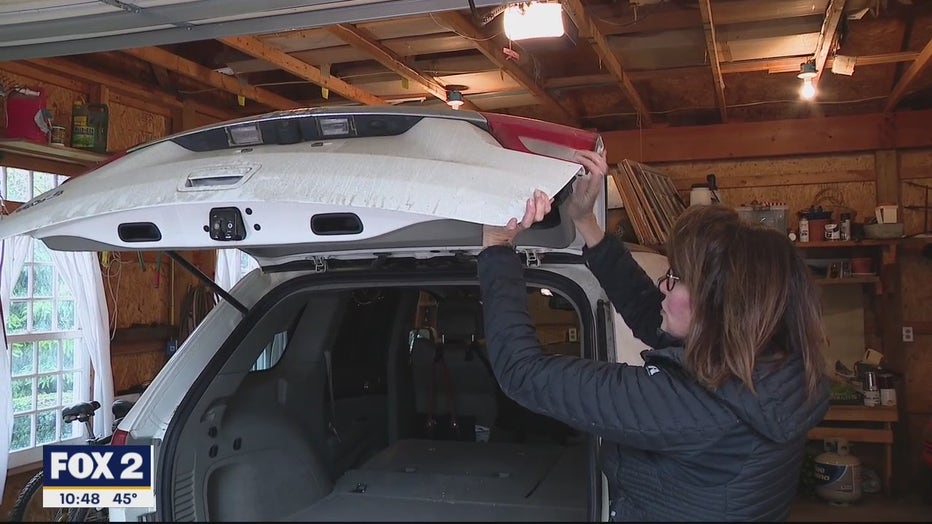
How to determine if your tailgate legs need replacing.

How do you know if your struts have failed? Well, if they're still holding the hatch or tailgate, they're probably still fine, says Jill. Even if they don't go all the way up, as long as they hold on, he said, you're in good shape.

In Jill's case, the tailgate stopped before it was fully raised. Jill thought they didn't need replacing as much as a little attention. Most likely, they will need cleaning and relubrication. Jill started with the little ball joints at each end of the strut where they join the vehicle.
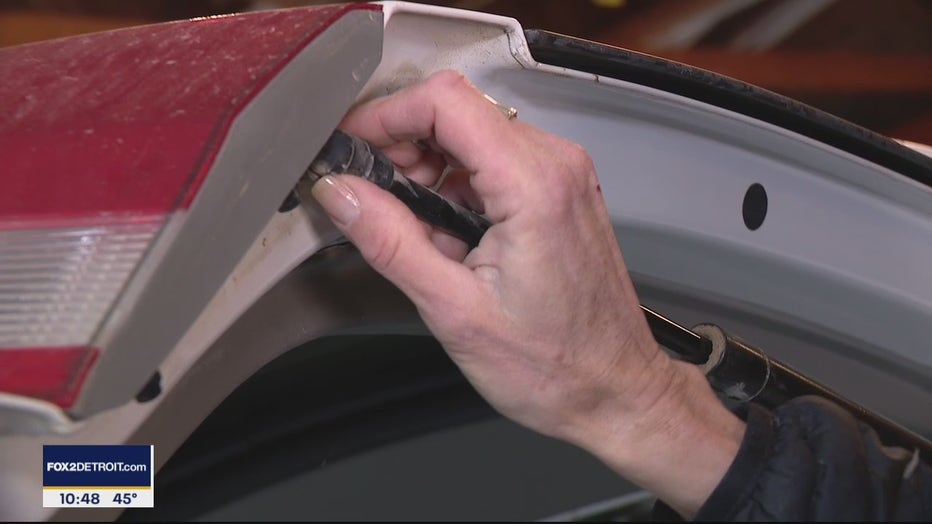
How to detach the tailgate legs from your vehicle.

To release them, you may need to loosen a screw attachment or loosen a spring clip. Jill's vehicle (2011 Grand Cherokee) had a clip on it. He used a small flat-bladed screwdriver to loosen the clip a little. Then he used needle-nose pliers to pry it out of the joint. Keep an eye on the clip, says Jill. You'll need to put it back in when you're done.

Once that was done, he used the needle-nose pliers again to move the joint.
**** TO BE PREPARED ****
You must have the tailgate open or have someone hold it as the tailgate will fall as soon as you remove one end of the tailgate. Tailgates and hatches are heavy, and one strut is not enough to hold one open. You don't want it to fall on your head or pinch your fingers. Removing the other end of the strut should be the same process. Of course, if you were to replace the strut you would simply reverse this process and mount your new strut now.
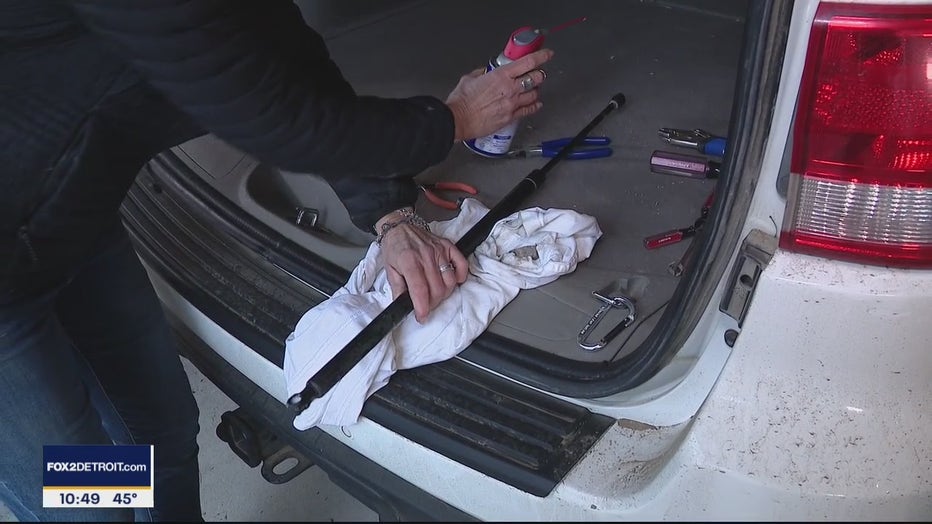
I'll show you how to clean the ball joints where the strut meets your vehicle.

If you're just waiting for it, your focus will be on cleaning the existing strut. Once you've completely removed it, Jill says, spray some WD-40 on the ends of the strut bushing and clean them with a rag. They are most likely quite dirty, and cleaning them will make the joints easier to move. Also, spray some WD-40 on the ball joints and wipe them off. More of a mechanical cleaner than a lubricant, WD-40 is perfect for these types of tasks. It also prevents water from entering.

When the joint ends are freshly cleaned, reattach the strut by placing the gland ends over the ball ends of the joints and secure them with the spring clip or screw bracket that you originally removed. Spring clips can be a little snotty, says Jill, to come back. You may need to use a screwdriver (or two) or needle-nose pliers to open them and snap them back into place. Jill recommends wearing gloves for this part to avoid pinching your fingers.

Once the strut is restored, it's time to look at the point where the rod enters the hydraulic piston section of the strut. This is a place where silt and dirt can build up, especially if you drive a lot of dirt roads like Jill. Dirt only finds one way. The jills were covered with packed earth. Once again, Jill used the small screwdriver and carefully pried the dirt off the joint. Once the dirt was gone, he wiped it off with a rag and applied a light lubricant. A 3 in 1 oil would work. Jill used Tri-Flow, which she also uses for bicycle chains, so she already had it in her store.

Jill says you may have to open and close the tailgate several times to help spread the lubricant. You may even need to reapply the oil right away to make sure you have enough to cover the dipstick while working on the tailgate. After this process, Jill immediately noticed that her back door worked more smoothly and fully extended, which hadn't happened in a while.

So you are on the right track for a better tail lift and you can potentially avoid going to the dealership or store.

PROJECT EVALUATION: Simply +

Click the video player above to see Jill walk you through the process.

Let's block ads! (Why?)

Some interesting and exciting beauty tips for your everyday life

High

A simple oral hygiene tip from a Dublin dentist, as a study suggests that gum disease can lead to stroke

We all dream of a Hollywood smile. Yet people tend to be complacent about taking care of our teeth, forgetting about flossing, not worrying about mouthwash, and putting dentist appointments on hold.

While the latter is partly based on fear, of course, nobody really likes the dentist's chair, but regular appointments with your dental hygienist could be the best thing you can do for your health this year.

It could even save your life.

This is evident from research from around the world, including a Swedish study of more than 1,600 people over the age of 26 that found a clear link between gum disease and stroke.

Last year, at its international conference, the American Stroke Association presented research showing that gum disease is associated with higher stroke rates due to hardening of the cerebral arteries and arterial blockages.

The Dublin Dentist , Dr. Ed O'Flaherty of Seapoint Blackrock Clinic stated, "With gum disease, you basically have a chronically open wound and you let everything in your mouth go into your bloodstream.

"So if you have bad bacteria around your mouth, those bugs can literally get into the bloodstream and look for a place to get infected. It can be the heart, where it can cause a heart attack or stroke. In this one." Case it causes a blockage. " the brain ".

He continued, "People tend to think of their teeth as their teeth, they don't appreciate the connection with the rest of their body.

"So people have bleeding gums and they ignore it. When their nails or eyes bleed, they run scared straight to the doctor."

Dr. O'Flaherty said dentists are facing a "tsunami" of serious problems in the coming months and years as clinics closed and people pressured to do so during the pandemic

He said, "The underlying cause is the buildup of tartar and plaque under the teeth. It is very difficult to remove all of the plaque from the teeth. The dentist will visit these areas because once it has built up you won't remove it yourself can ...

"Symptoms of gum disease often don't appear, so it's important to see a dentist regularly who can spot these types of problems much earlier."

"Cleansing changes the types of bacteria in your mouth. Instead of those bacteria that cause all of these problems, you have a much healthier type of bacteria."

He added, "Bleeding gums would definitely be a sign of concern. If you see it don't ignore it, get it checked out.

To keep teeth as healthy as possible between appointments, she suggested, "Use a strong mouthwash like Corsodyl to disinfect your mouth.

"Use a very good toothbrush, preferably electric, as it removes more plaque and a jet of water to clean between teeth."

Let's block ads! (Why?)

5.01.2021

PET TIPS: Toxic substances for your pets

Hi friends, Tuki is here on my Potter League post. I thought you were aiming to be sure that you are choosing harmful pets.

Dangers inside

Food: There are many foods that people love that are not good for the furry members of your family. Some of the most common are chocolate, coffee, tea, avocado, raisins and raisins, onions, garlic, and anything that contains the artificial sweetener xylitol. The xylitol is used in products with no success, without chewing gum and without beurre d'arachide - and in many cases where the Plupart des Chiens worships the beurre d'arachide, also the verification of the Avant de le Donner à Votre Hund! You should also keep the trash out of the reach of your pets as old or rotten food can contain mold or bacteria that can cause food poisoning. That's probably why you threw it away first.

Detergents: You may not think pets are interested in detergents. After all, the only cleaning they do is their own fur! However, the smell of some products is attractive to pets. Detergents that contain bleach can cause drooling, vomiting, and diarrhea or throat burns if swallowed. Always follow the directions on the pet label and store products in a secure closet, preferably out of the reach of your pets. We know how curious you can be!

Medication: All of your medications (including those for your pets!) Should be kept out of reach. Many drugs that people often keep at home are especially dangerous for pets. These include ibuprofen (Advil), acetaminophen (Tylenol), cold medications, antihistamines, diet pills, and antidepressants. If your pet is on prescription medication, keep them out of reach as well. Even if medication is prescribed for your pet, it can be dangerous to take on its own.

Insecticides: Any product used to kill insects in the home should be stored and used in an area inaccessible to your pets. These products are designed to be deadly to insects, but they can also be deadly to your pets. Follow all directions on the label. This includes flea and tick treatments. For example, never use a dog product on your cat and always consult your veterinarian with any questions.

Indoor and outdoor hazards

Some hazardous products are found indoors and / or outdoors and can be stored in a garage or shed. Don't leave your pets alone in a place to keep them. You may think your pets will not get anywhere near these products, but sometimes the smell or texture can attract them and they will investigate!

Insecticides and Herbicides: Any product used to kill insects or weeds can be harmful to your pet if ingested. When placing any of these products in your yard or lawn, follow the manufacturer's instructions to keep your pet away. When wet, these products come in contact with your pet's paws and can cause an upset stomach, or worse, if those paws lick each other.

Paints and Solvents - Most latex or acrylic paints only cause mild stomach ache, but other types of paints, such as artist paints, contain heavy metals and can poison your pet. Solvents can also cause burns if swallowed or in contact with your pet's skin.

Antifreeze - You may not be using antifreeze at this time of year. However, if you've kept it in your garage or shed, make sure it's sealed and out of reach. Pets are often attracted to the sweet smell and content of ethylene glycol, the main ingredient in antifreeze, and ingesting even a small amount can be fatal.

Adhesives and Adhesives: Adhesives and adhesives can be fatal if swallowed, even in very small amounts. This is especially true for polyurethane adhesives and wood glues that contain diisocyte diphenylmethane (MDI). When ingested, these products expand in your pet's throat or stomach, causing a blockage.

Plants - There are many indoor and outdoor plants that can be dangerous to your pets. Some of the most common are lilies, which are very poisonous to pets, even in small quantities. (Interestingly, lilies are related to onions, which are also poisonous to pets.) Some herbs, such as lily of the valley, oleander, yew, and foxglove, can cause heart problems when consumed. Azaleas, rodendro, tulip and daffodil bulbs, ivy, hydrangea and rhubarb leaves are other common dangerous plants in this region.

Aerosol Products - If you have a pet bird, it is particularly sensitive to aerosol products such as air fresheners, cigarette smoke, and certain adhesives or paints. Keep your bird in a different room when using these products. Cooking fumes are also a potential hazard to birds (not a criticism of others' cooking skills!) And should be kept away from the kitchen.

Like I said, animals can be curious! What if your pet gets caught in something potentially dangerous? Immediately call your veterinarian or the ASPCA Animal Poison Control Center at 1-888-426-4435. If your pet needs treatment, take the product container or a sample of the plant with you so that treatment can begin as soon as possible.

See you next time my friends

Tuki

Email your questions to Tuki, PO Box 412, Newport, RI 02840, or email TukiTalk@PotterLeague.org. The Potter League for Animals can be found at 87 Oliphant Lane in Middletown and online at potterleague.org.

Let's block ads! (Why?)

PG&E gives tips on forest fire safety

Pacific Gas & Electric Company representatives recently spoke in a virtual town hall about the security measures at the Humboldt County's utility company.

Over the past several years, Pacific Gas & Electric Co. has taken a number of specific steps to improve customer service and strengthen the Wildfire safety program.

One step is to install weather stations that will provide specific data to help determine when a public safety power outage or PSPS event is required. PSPS events occur when certain power lines are shut down for public safety reasons due to extreme weather conditions. This is to prevent branches and other foreign bodies from coming into contact with live cables.

As of 2018, PG&E has installed 34 weather stations in Humboldt County, including one along Grizzly Bluff Road near Ferndale. Unless you're specifically looking for this weather station, you will likely pop by without realizing it.

It is connected to a PG&E roadside power pole and continuously transmits data that is used to improve forecasting and weather modeling. These weather stations provide temperature, wind speed and humidity data, which are monitored, recorded and evaluated by the PG & E meteorological team.

"As a real-time situational awareness tool, we can leverage our high-density weather observation network at the start of a public safety blackout event to assess whether or not critical fire conditions are occurring," said Ashley Helmetag, senior meteorologist at PG&E.

Additional weather stations are located on Ridgewood Drive, Island Mountain Road, Mattole Road and near Kneeland, Yager Junction, Bridgeville, Snow Camp Lake, Fort Seward and Fruitland.

Seven high resolution cameras have been installed in Humboldt County to detect forest fires. Two are in Bald Jesse near the Yager Valley, two in Patton Hill, east of Miranda, two in Mail Ridge, in the Alderpoint / Harris areas, and one in Barry Ridge in Kneeland.

Weather stations and cameras are located in areas of high fire risk as determined by the California Public Utilities Commission. These tiled areas are home to more than 7,100 Humboldt County's PG&E customers, with level 2 representing a high forest fire threat and level 3 representing an extreme forest fire threat.

PG&E also carried out vegetation management improvements along the 54-mile PG&E line in Humboldt County. In this part of the program, greater safety distances were established between power lines and the surrounding vegetation in areas with a high risk of fire.

"PG&E is prioritizing its forest fire safety work in the areas most exposed to forest fire risk and in places where the public safety impact of power outages is reduced for most customers," said Deanna Contreras, spokeswoman for PG & E.

PG&E also offers tips on how to prepare and protect homes from forest fires.

"You can dramatically improve your home's chances of surviving future wildfire through material choices, design and installation options, and regular maintenance," said Contreras.

The council includes creating a defensible space around a structure, keeping the gutters clean, and drawing up an evacuation plan.

For information and videos on preparing your home and family for the forest fire season, visit https://www.safetyactioncenter.pge.com. For more information on PG & E's forest fire safety program, please visit www.pge.com/cwsp .

Let's block ads! (Why?)

It's the details that count - some photo processing tips

Anyone familiar with Karl Shakur's work is aware of his creativity, extreme attention to detail, and recognizable style. This video you made during the COVID shutdown quickly describes how to use Lightroom and Photoshop to achieve consistent color grading and clean aesthetics (although I was able to accomplish all of these things using Capture One Pro).

Karl does an excellent job here, clearly and concisely addressing some key issues related to processing and the importance of consistency in color grading across projects or entire portfolios, as well as the process of cleaning up your image to get a professional quality end product . . Regardless of whether the images he produces speak to you objectively or not, it is undeniable that his portfolio is incredibly aesthetic because of his obsessive color consistency. Furthermore, it cannot be denied that there are no frivolous objects or distractions in any of his compositions. This short video is your chance to take a look at how to do it as you work.

There are so many helpful videos out there exploring the challenges we all face in just about every aspect of photography. Sometimes the techniques or solutions are so simple, but it takes a little perspective or an outside explanation to get to that "ah ha" moment. For me, this video offered some "ah ha ha" moments that definitely improved my workflow. I let you see, learn and experience your own moments.

Let's block ads! (Why?)

4.30.2021

Tips to prevent bed bugs from wrecking your car this season

[Full text content cannot be retrieved]

You can wash the car, apply an extra layer of wax as a protective coating, clean the bugs with a damp drying sheet, or use a damp, soapy paper towel.